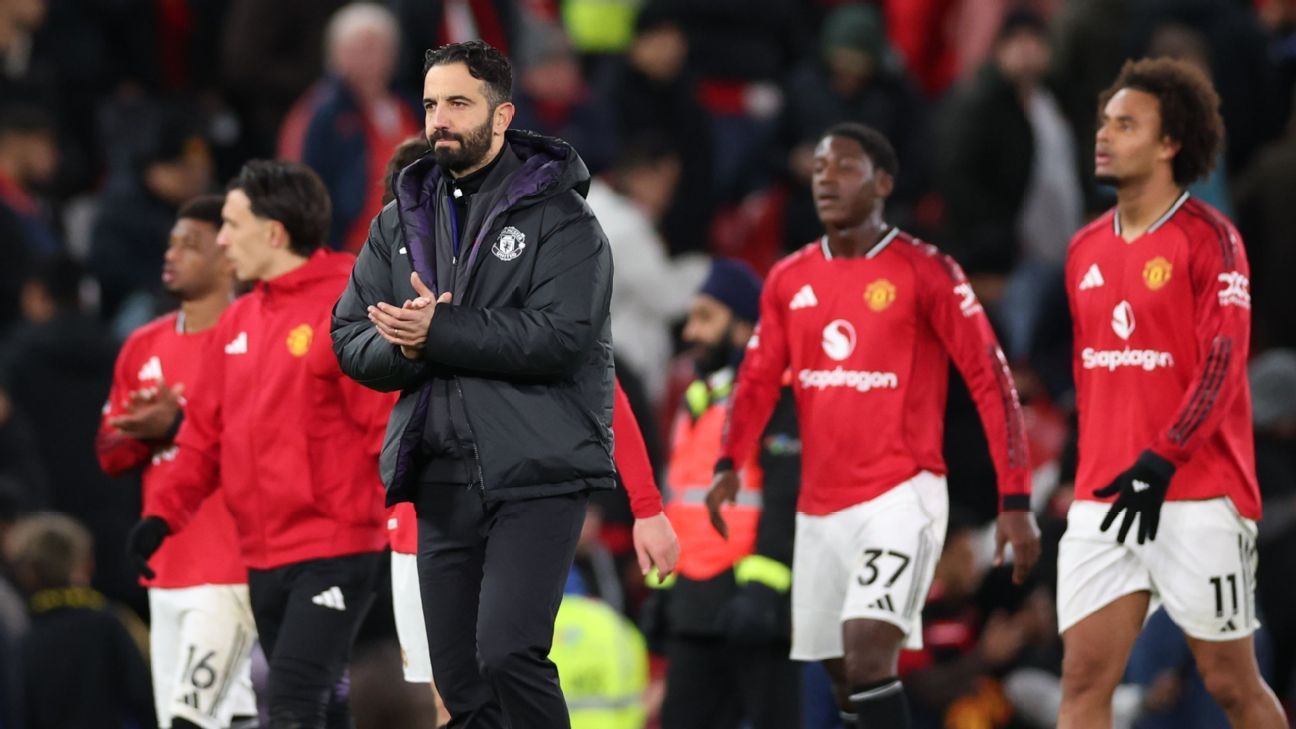
Man United has made progress with Amorim, but underlying statistics reveal issues.
The Manchester United Transformation: A Year Under Ruben Amorim
In the world of football, few clubs can match the storied legacy of Manchester United. Yet, in recent years, the echoes of glory have been dulled by a series of managerial shifts and fluctuating performances. A little over a year ago, the club’s management made a decision that rippled through the footballing community: sacking Erik ten Hag, a move that came mere months after a review concluded he would remain at the helm. Fast forward to now, under the leadership of Ruben Amorim, a question arises: has Manchester United improved, or are they still grappling with the same demons?
Amorim’s Tactical Philosophy
Ruben Amorim arrived at Manchester United during a turbulent time, inheriting a squad that was struggling for identity and results. His tactical approach has primarily centered around a 3-4-3 or a 3-4-2-1 formation, a daring choice that diverges from the traditional setups many clubs favor. “I won’t change my philosophy,” he proclaimed early into his tenure. This steadfast commitment to his style hinted that any transformation at United would be anchored in his vision of the game.
Statistical data underscores the initial struggles under Amorim, where the team’s ball movement was notably lethargic. During his first spell, the squad averaged a glacial 0.98 meters per second when advancing the ball—a lamentable second-slowest in the league. This sluggishness meant they often recycled possession within their own half instead of launching effective offenses. However, the winds of change seem to be blowing this season.
Amorim has invigorated the team’s style of play. Through the first twelve matches of the current campaign, Manchester United has embraced a higher-tempo approach while still maintaining control of the game, a significant departure from last year’s inefficiencies. The results of this new aggression reveal a richer fabric of play and are beginning to yield tangible results.
Evaluating Performance Metrics
A deeper analysis of key performance metrics reveals the evolution of Manchester United under Amorim. Last season, their adjusted goal differential—a blend of expected goals and actual goals—stood at minus-0.16. This year, that figure has improved to plus-0.20, showcasing a marked effect of the tactical shift. Furthermore, the team is scoring more goals (1.67 per game) while their defensive record has dipped slightly (1.46 goals conceded per game).
This new paradigm shifts the focus from just perfecting defensive solidity to balancing aggression with strategic defenses. It is apparent that while the team has become more vulnerable at the back, the enhanced offensive threat makes it a worthwhile trade-off. Amorim’s ability to entice a more proactive mindset among his players illustrates his potential as a developing coach; a young manager who has room to grow right alongside his squad.
Despite these improvements, it’s crucial to assess the broader context in which they exist. The turnover of players has played a significant role in transforming United’s offensive dynamics. The arrival of new forward options such as Bryan Mbeumo, Matheus Cunha, and Benjamin Sesko has injected fresh energy into the lineup, enabling them to capitalize on Amorim’s revised tactical framework.
Analyzing the Sustainability of Change
While statistics and recent matches may paint a positive picture, the question remains: how sustainable is this shift in performance? Luck has certainly been a generous companion to United this season. An early advantage against Chelsea along with a series of fortunate red cards in key games have inflated their expected goals and shots statistics. The reality is that while they appear to be improved, much of this success might be riding on tenuous circumstances.
Examples of their favorable breaks appear when analyzing their penalty records continually favoring them, resulting in multiple penalties awarded while conceding none. This unusual statistic distorts the overall expectancy of their performance—if the tide were to turn, those numbers might equalize, revealing a truer reflection of the squad’s capabilities.
Moreover, Amorim’s focus on a senior-heavy squad has also raised eyebrows. By increasing the average age of the team, with players like Casemiro and Bruno Fernandes driving play, are they sacrificing long-term potential for short-term gains? Gallagher’s analysis hints at this tension: the balance between win-now urgency and future possibilities is becoming increasingly fragile.
The Road Ahead: What’s Next for United?
With a mixed bag of performances from the current campaign, the path ahead for Manchester United and Amorim is anything but clear. Next, they’ll face some demanding opposition during a pivotal stretch of fixtures, including matches against established competitors like Arsenal and Manchester City. These games will likely serve as true gauges of their evolutionary progress.
While Amorim’s initiation into the club has brought them out of the depths of despair into a realm of mediocrity, it is still a waiting game to discover whether this evolution can morph into effective long-term solutions. How the manager adapts, not only to the challenges posed by the other top clubs but also in cultivating a cohesive unit capable of sustaining this style when luck isn’t on their side will remain crucial.
In this critical juncture where Manchester United finds itself, fans are left with a complicated mix of hope and skepticism. Under Amorim, they are not quite yet back amongst the elite, but the team has taken strides towards respectability—a trek that will require continued effort and focus as they navigate through a demanding league. As they continue through the season, it will be fascinating to observe if they can cement this newfound identity into something palpitatingly competitive.