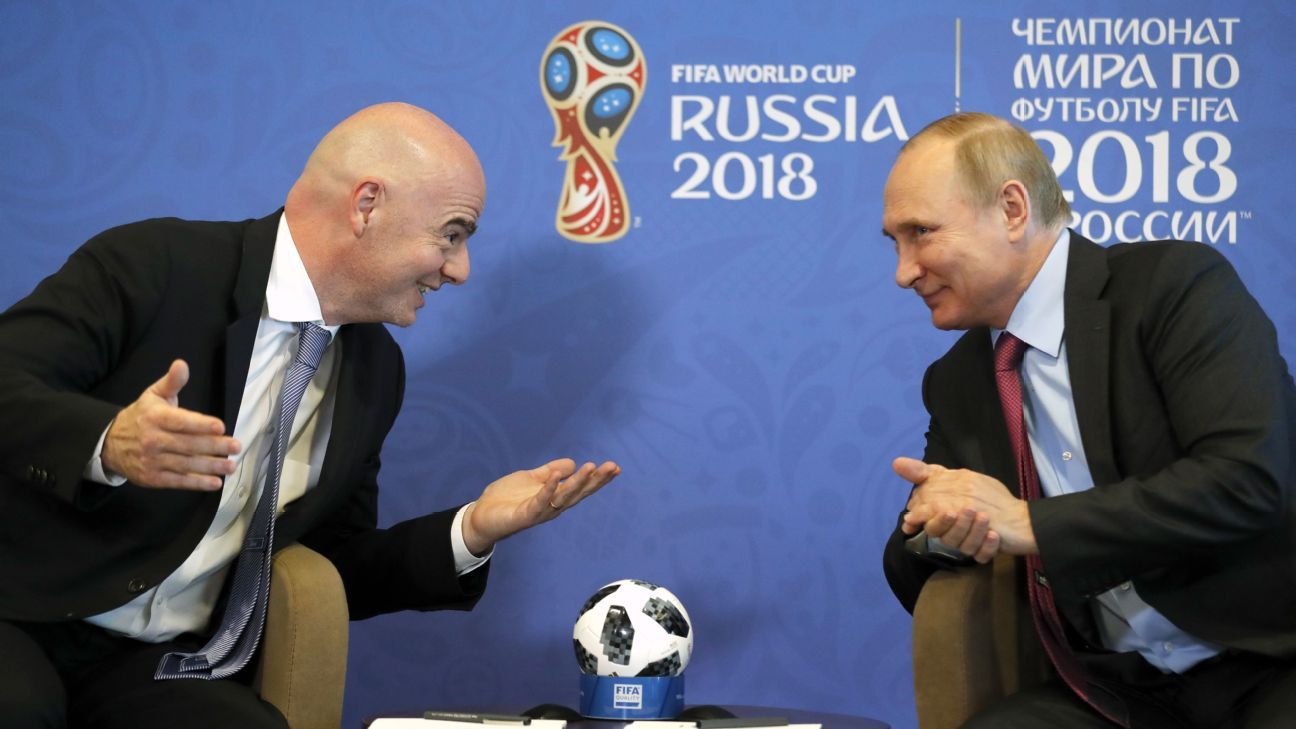
Gianni Infantino supports the removal of FIFA’s ban on Russia.
Infantino’s Controversial Stance on Russia’s Return to International Football
The Background of the Ban
In response to the geopolitical crisis ignited by Russia’s invasion of Ukraine in February 2022, FIFA along with UEFA jointly decided to suspend Russia from international competitions. This ban effectively barred the Russian national teams, including the men’s and women’s squads, from participating in events like the 2022 World Cup. The reasoning behind the suspension was straightforward: sports bodies sought to distance themselves from a nation whose military aggression contradicted the spirit of international sporting cooperation.
Initially met with public support, the ban was seen as a necessary stand against war and a means to exert pressure on the Russian government. However, as the conflict has dragged on, sentiments have evolved, prompting figures like FIFA President Gianni Infantino to reassess the impact of such measures.
Infantino’s Recent Comments
Recently, Infantino voiced a controversial opinion that has stirred the waters once more. Speaking at the Women’s Champions Cup in London, he stated that the ban has “achieved nothing” and that it should be reconsidered, especially for youth teams. “This ban has only created more frustration and hatred,” he emphasized, suggesting that allowing young Russian players to compete outside their country could serve as a bridge for better understanding among nations.
This standpoint reflects a growing sentiment among some stakeholders who believe that sports can act as a conduit for peace and dialogue. Infantino’s comments come amid increasing calls for Football to serve its traditional role as a unifier, rather than a dividing force.
Support and Opposition
Infantino’s remarks have ignited a mixed response from within the football community. On one hand, some argue that reintroducing Russian youth teams could foster a sense of normalcy and allow for a generation of players to engage in sportsmanship and camaraderie, separated from the political turmoil. It echoes the age-old belief that athletics can transcend national divides and foster global community.
On the other hand, a significant faction within the sport’s governing bodies vehemently opposes any move to reintegrate Russia into international competitions. UEFA President Aleksander Ceferin has made it clear that, under the current circumstances, Russia will not be welcomed back until the war ceases. Many member federations, driven by their own political sentiments and the ongoing suffering in Ukraine, share this perspective and warn that re-admitting Russian teams could send the wrong message about global accountability and moral responsibility.
UEFA’s Decision-Making Process
UEFA is set to convene its executive committee for deliberations regarding Infantino’s comments and the broader policy on Russia’s status in the global footballing landscape. This meeting is key, as UEFA retains the authority to dictate the terms under which any nation is welcomed back into the fold of competitive football. The complexities of international relations often seep into the governing of sport, and UEFA’s position will likely reflect the prevailing political sentiment.
Additionally, the evolving situation could pose a long-term challenge. There are precedence and public sentiment factors to consider; as demonstrated earlier this year, when UEFA initially reduced restrictions for some youth categories, backlash led to a hasty reversal. Thus, decisions made now could either pave the way for gradual reconciliation or fortify isolation based on the responses received from the wider football community.
Russia’s Continued Involvement in Football
Despite being suspended from major tournaments, Russia has not been completely sidelined from the footballing world. The nation has engaged in international friendly matches, allowing their teams to remain active on the pitch albeit outside of formal competitive frameworks. This dynamic has raised questions about the efficacy of the ban. If Russian teams can continue to play, are they truly being excluded from international football, or is this a partial acknowledgment of their right to participate in the sport?
Moreover, FIFA recently announced plans for new youth festivals, slated for U15 boys in 2024 and girls in 2027, affirming that these events will be open to all 211 FIFA member associations. This inclusivity hints at possible future shifts, but it also underscores the ongoing complexities of football’s relationship with global politics. The mixed messages leave stakeholders waiting for a clearer policy direction.
In light of these developments, the international football community stands at a crossroads: how best to balance the beautiful game with the intricate layers of global politics and humanitarian considerations. The discussions sparked by Infantino’s remarks will undoubtedly shape the future of international football and its role as a platform for dialogue, unity, or continued division.