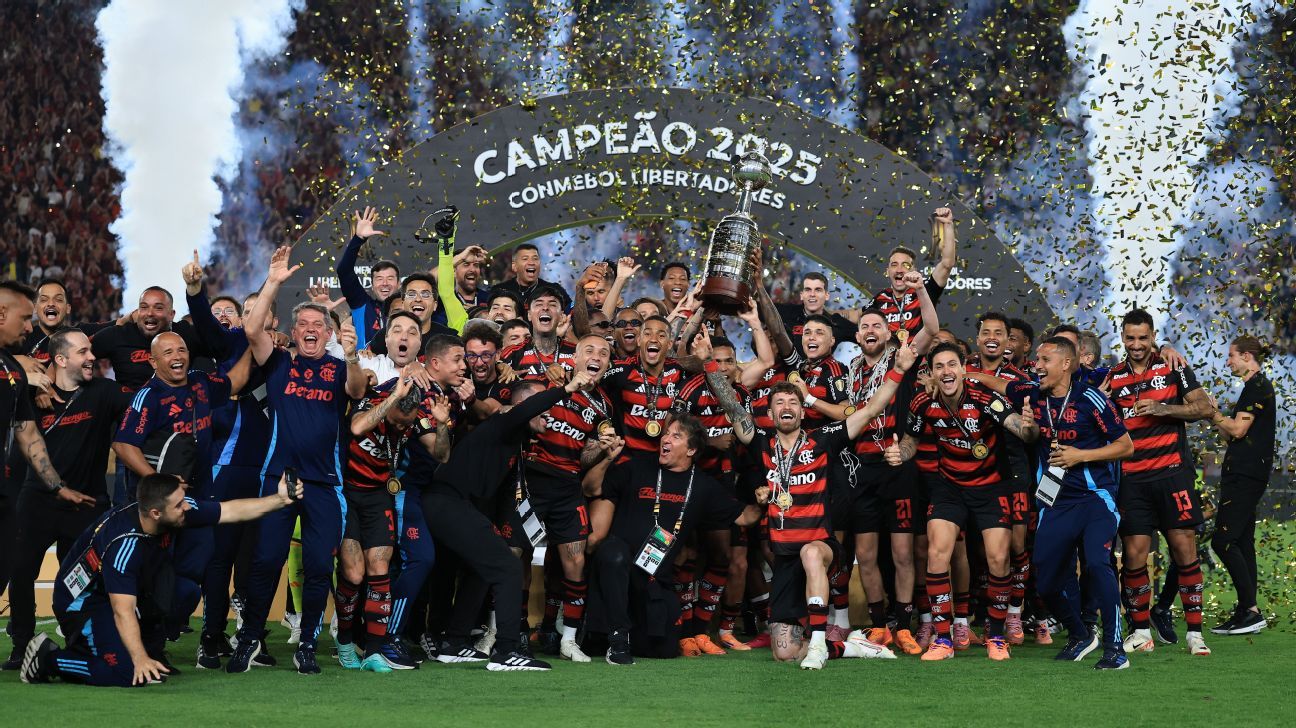
Flamengo Claims Copa Libertadores Title, Yet Brazilian Players Appear Worn Out
Brazil’s Copa Libertadores Legacy: An Unprecedented Domination
The Copa Libertadores, often heralded as the crown jewel of South American club football, has seen the Brazilian teams dominate the tournament in a manner never before witnessed in its storied history. As the nation secures seven consecutive titles — an extraordinary feat unmatched by any other country — it raises questions: How has Brazil achieved such supremacy, and at what cost?
The Rise of Flamengo and Palmeiras
At the forefront of this dominance, two powerhouses, Flamengo and Palmeiras, have established themselves as the titans of South American football, claiming five of the last six titles between them. Their consistent performance in the Libertadores highlights their significant investment in talent, strategy, and infrastructure, allowing them to transcend the competition.
In recent seasons, Flamengo showcased their prowess with a thrilling 1-0 victory in the recent Libertadores final, demonstrating their tactical acumen and high-stakes mentality. Meanwhile, Palmeiras — known for their depth and resilience — has made their presence known, consistently vying for not only continental glory but also national supremacy in the Brazilian Serie A.
The significance of this rivalry cannot be understated: these two teams have effectively set the stage for South America’s elite football narratives, raising the bar for their competitors. The dominance of Flamengo and Palmeiras is not merely a reflection of skill or tactics; it is symptomatic of a generation of players honed in an environment that demands excellence.
A Grueling Schedule and Its Toll on Players
However, with immense success comes an equally staggering workload. The accumulation of match minutes for the players of Flamengo and Palmeiras has reached what many could argue is an unsustainable level. Players, often representing national teams in international windows, find themselves jettisoning between continents and competing in high-stakes matches without sufficient recovery time.
Consider a recent scenario: players representing Brazil found themselves in action in Europe, Mexico, and the United States on a Tuesday, only to return home for a critical league match the following day. The inadequate recovery periods take a toll not just physically but mentally as well, leaving players vulnerable to burnout and injury.
This cycle of continuous play places immense pressure on coaches to manage their squads astutely, balancing player fatigue against the critical demand for results. Coaches like Flamengo’s Filipe Luis are often tasked with making tough decisions regarding player rotation and fitness, particularly in grueling competitions that require a sustained performance where exhaustion can easily lead to lapses in concentration.
The Tactical Battle: A Clash of Styles
The recent Copa Libertadores final serves as a perfect case study to analyze the interplay of tactics within this intense rivalry. Unlike their previous league encounter, a high-scoring affair won by Flamengo 3-2, the final was an attritional battle with fewer openings and less flair. Palmeiras’ coach, Abel Ferreira, adopted a cautious game plan, relying on his players’ defensive capabilities while trusting that opportunities would arise if the game remained scoreless.
This strategy, while grounded in sound logic, ultimately proved the wrong approach when Flamengo executed their own game plan successfully. A single moment of lax marking during a corner kick turned the tide, giving Flamengo’s Danilo, who stepped in due to injuries impacting the attacking roster, the opportunity to score the decisive goal.
Such tightly contested matches emphasize how tactical flexibility is crucial in high-pressure situations. While Flamengo had relied on a free-flowing attack during the domestic league, the Libertadores demanded a more measured approach, demonstrating the ability of both teams to adapt under duress.
Looking Ahead: The Intense Schedule Continues
As Flamengo prepares for a hopeful victory in the Brazilian Serie A while simultaneously gearing up for the Intercontinental Cup, the question looms: How much longer can they sustain this grueling schedule? With a potential tie against Cruz Azul and subsequent matches that include competing against Pyramids FC and even Paris Saint-Germain, the pressure on players remains unabated.
In light of this relentless calendar, many are suggesting that the quality of football might benefit from a reexamination of the structure and scheduling for both domestic and international competitions. Such adjustments might allow for adequate recovery time, enhancing player welfare and ultimately ensuring that the beautiful game maintains its high standards for fans and players alike.
While success in the Copa Libertadores has undeniably etched Brazil’s name in football history, the ongoing demands on players cannot be ignored. As the saga unfolds, the nation’s footballing giants must navigate the fine line between triumph and toll, all while fans and analysts alike watch with keen interest.